Classroom bingo games that teach: vocabulary, maths and reading
Updated October 13, 2026 · 5-minute read · 7 sections
Bingo teaches something only when students have to think between the call and the mark. Call "a word that means very happy" and let them find ecstatic, and you have a vocabulary quiz that thirty children will beg to repeat. Call the word itself, and you have a listening game.
Call the clue, print the answer
Every format below follows the same pattern: the card shows answers, you read out the questions. The list you paste into Words mode is the list of answers, one per line. Keep your questions on a separate sheet, in the same order, so you can tick them off.
A trap with maths: different questions can share one answer. "4 × 6" and "3 × 8" are both 24. That is fine as long as you decide in advance that 24 can be marked once, and you only call one of them per game. The generator removes exact duplicate answers anyway and tells you how many it dropped.
Ten classroom bingo games
| Game | Ages | On the card | You call |
|---|---|---|---|
| Vocabulary | 8 and up | The words | A definition or synonym |
| Times tables | 7–11 | Products: 56, 42, 81 | "7 × 8", "6 × 7" |
| Addition facts | 5–7 | Sums up to 20 | "9 + 6" |
| Sight words | 4–7 | the, said, was, they | The word, used in a sentence |
| Phonics | 4–7 | ship, chip, thin, whale | A sound: "sh" |
| Foreign language | Any | Words in the new language | The word in English, or a picture |
| Science terms | 9 and up | photosynthesis, mass, atom | A definition |
| History | 10 and up | People or events | A one-line clue |
| Capitals | 9 and up | Capital cities | The country |
| Unit review | Any | Key answers from the unit | Short questions from your test bank |
For the youngest children use pictures you draw on the board or hold up, and short words on the card. For older students, make the clues harder than the answers: "the process plants use to make food from light" is a better call than "photosynthesis, spelled out".
The generator can hold both halves for you: type each line as 7 × 8 | 56 — what you call on the left, what goes on the card on the right. The cards show only the answers, while the Caller tab and the caller's sheet show the question to read out, so you never have to work out the clue on the spot.
Grid size and list length by age
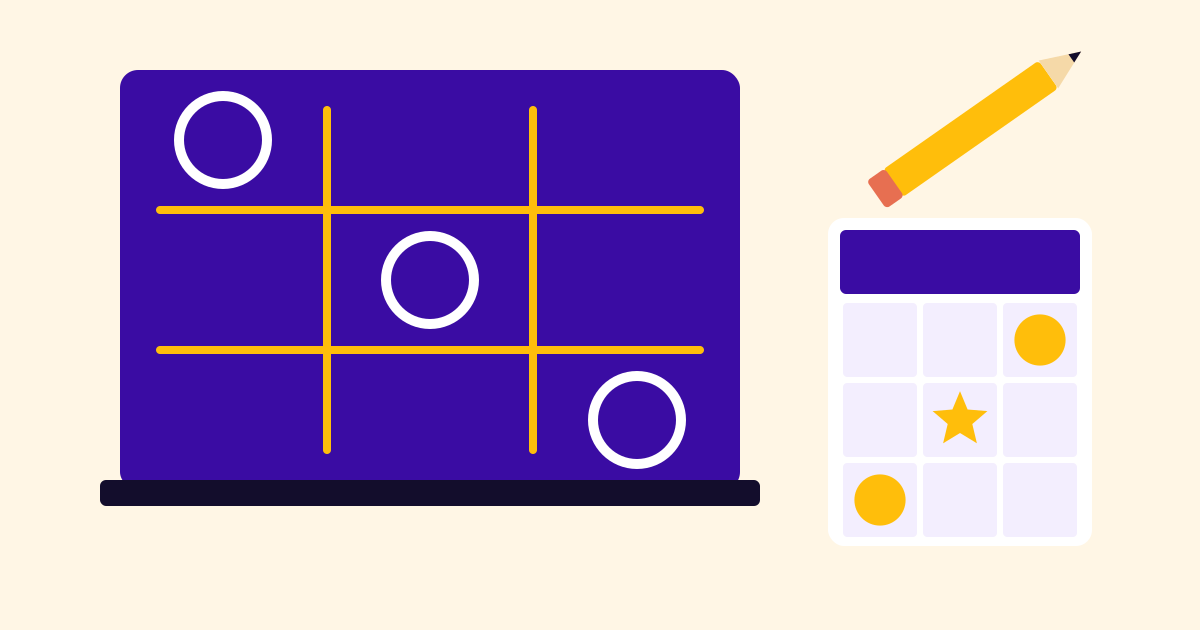
Little ones lose focus on a 5×5 card. My rule of thumb:
- Ages 4–6: 3×3 with the FREE centre — 8 squares, games of a few minutes. A list of 16–24 words.
- Ages 7–9: 4×4 — 16 squares. An even grid has no centre square, so no FREE. A list of 32–48.
- Ages 10 and up: 5×5 with FREE — 24 squares. A list of 48 or more; 30–40 still works.
The list length is what decides whether the game is fair. With a list exactly as long as the card — 24 words on a 5×5 with FREE — every card has the same words in a different order, and a full-card game ends with the whole class shouting on the same call. With 25 words there are only 25 different word sets. With 40 words there are 62,852,101,650. The tool shows that number under the settings, so you know before you print.
A bingo lesson, start to finish
- Write the answers, one per line, and the matching clues on a separate sheet. Twenty minutes the first time, five once you have a list per unit.
- On the bingo card generator choose Words, paste the answers, pick the grid, set Number of cards to the class size plus two, and Cards per page to 2 or 4.
- Print with the Caller's sheet. Write the Set code on your clue sheet so you can reprint the same deck next term.
- Explain the pattern before you start: one line for the first game, four corners or a full card later.
- Call clues in random order. Tick both the clue sheet and the caller's sheet.
- When a student calls bingo, they read the answers in their line aloud and say which clue each one matched. That is the real learning moment — do not skip it.
- After the game, ask the class for the clues nobody marked. Those are your review list.
Avoiding "everyone wins at once"
Besides a list that is too short, two things cause mass wins. One is calling the same set of clues for every game: students learn which answers come up first. Shuffle the order each time. The other is playing blackout with a small class and a small list. Play lines instead, and save the full card for a list three times the size of the card.
If you want the opposite — a calm game where everybody finishes — print with a short list on purpose and play blackout as the end-of-lesson review. Just tell students it is a race to finish, not to win.
Mixed abilities and a noisy room
Bingo rewards speed, which can leave the same three students winning every week. A few adjustments I use:
- Pairs: two students share one card and must agree before they mark. The stronger reader explains, the other one checks — and the room gets quieter, because they whisper to each other instead of shouting.
- Wait time: read the clue, count to five in your head, then read it again. Nobody marks until the second reading.
- Two levels of clue: for vocabulary, give the definition first; if most heads are still down, add an example sentence.
- Winners call: the first winner becomes the next caller and reads the clues. Fast finishers get a new job, and the game slows to a pace everyone can follow.
Prizes do not need to be sweets. Choosing the next game, lining up first or a sticker on the reading chart work just as well with most classes.
Reusing cards
Paper cards for 30 students every week add up. Print once on card stock and slide each card into a clear sheet protector; students mark with dry-erase pens and wipe them at the end (Tim van de Vall suggests the same for any set you will play again). Store each set in an envelope labelled with the topic, grid and Set code. If a card goes missing, reprint just that number with the same Set code and settings.
Questions and answers
How do you play vocabulary bingo?
Print the words on the cards and call out definitions or synonyms. Students mark the word that matches; a winner reads back each word with its clue.
What grid size is best for young children?
A 3×3 card with a FREE centre for ages 4–6, then 4×4 for ages 7–9 and 5×5 from about ten.
How many words do I need for a class bingo game?
At least as many as the squares, but two to three times that keeps cards different: 48 or more for a 5×5 card with FREE.
Can I reuse classroom bingo cards?
Yes. Print on card stock, put each card in a sheet protector and use dry-erase pens. Keep the Set code to reprint lost cards.