How to host a bingo night: calling, patterns, prizes and cards
Updated October 13, 2026 · 6-minute read · 6 sections

Most arguments at a bingo night start with one sentence the caller forgot to say: what we are playing for. Announce the pattern before the first ball, every game, and half your problems are gone. The other half are cards, pace, prizes and how you check a claim, and all of them are easier to settle before anyone sits down.
Before the night: cards, markers and prizes
Count players, not tables. If people keep the same card all evening and mark with chips or dry-erase pens, print one card per player plus about 10 % spare: for 45 guests that is 45 × 1.1 = 49.5, so 50 cards. If every game uses fresh paper, multiply by the number of games first. Regulars often want two or three cards at once; beginners, children and most care home residents are happiest with one.
Spares matter more than people think. Someone always arrives late, a card gets coffee on it, a child wants "the purple one". Because every card carries a number and a Set code, you can print one more later that matches the deck: same Set code and settings, Number of cards one higher, and the earlier cards stay exactly as they were.
- Markers: bingo daubers for paper you throw away; chips, buttons or dry-erase pens for cards in sheet protectors. In a care home I use big plastic chips — they are easier to pick up than a dauber is to aim.
- Caller's kit: the printed caller's sheet, a pen, and either a ball cage or the Caller tab on a laptop or tablet.
- Prizes: several small ones beat one big one. A chocolate bar for a line keeps people interested; save the main prize for the full card.
- Card size: 1 or 2 per page for older eyes, 4 per page for children, a strip of 6 tickets per page for 90-ball.
Which patterns to play, and in what order
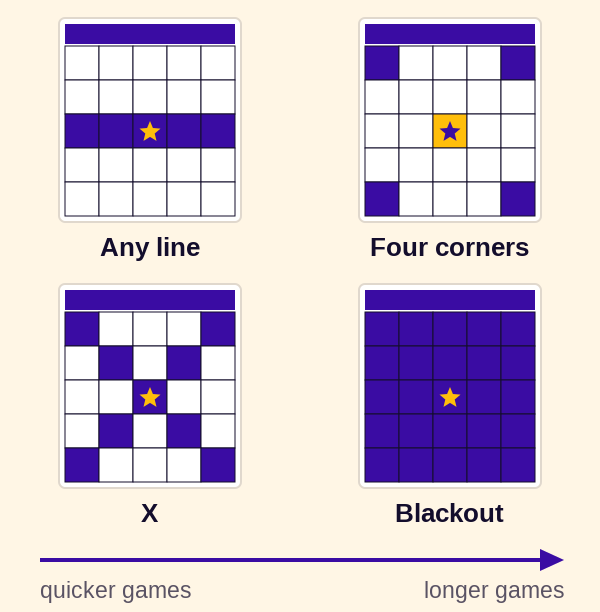
Start with something quick so everybody learns the routine, and finish with the long game. Here is how I plan a 75-ball evening:
| Pattern | How it looks | How long it runs | Best for |
|---|---|---|---|
| Any line | A full row, column or diagonal | Short | Warm-up, children, first-timers |
| Four corners | Only the four corner squares | Short, but swingy | A quick game between longer ones |
| X | Both diagonals | Medium | A mid-evening game |
| Blackout (coverall) | Every square | Longest | The final game and main prize |
| One line (90-ball) | All five numbers in one row of a ticket | Short | First prize of every 90-ball game |
| Two lines (90-ball) | Two rows on the same ticket | Medium | Second prize, same game |
| Full house (90-ball) | All 15 numbers on one ticket | Longest | The game's top prize |
90-ball works differently from 75-ball: one game has three prizes. You call until someone has one line, check it, pay it, and keep calling on the same tickets for two lines, then for the full house. Two lines must be on the same ticket — a line on ticket 2 and a line on ticket 5 of a strip is not a win (bingorental's explainer sets out the same rule). Some halls also play four corners on 90-ball tickets: the first and last number of the top and bottom rows (Wikipedia, British bingo).
Calling: pace and voice
Say the pattern, then "eyes down", then the first ball. Read each number twice with its letter for 75-ball: "B… twelve. B-12." For 90-ball, the number is enough, and many rooms enjoy the traditional nicknames — keep them if your crowd knows them, skip them if half the room is new.
Pace is a judgement call. My rule: watch the slowest player, not the fastest. In a care home I wait until most heads come back up before the next number, which can mean 15–20 seconds. A party of regulars can take a call every 8–10 seconds. If someone asks "what was that?", repeat it — a missed number turns into a disputed win later.
Tick every call on the caller's sheet or let the Caller tab mark the board. Both give you what you need when someone claims: a complete list of what has been called.
Checking a claim
The standard rule in UK halls is that a player must call "bingo" on the winning number, before the next one is drawn. If they notice it three numbers later, the claim is late. Decide whether you enforce that strictly — I relax it for children and care homes, and say so at the start.
- Stop calling. Do not draw another number until the claim is settled.
- Ask for the card number and have the player read out the numbers in the winning line.
- Check each one against the caller's sheet, or type the card number into Check a card on the Caller tab and pick the pattern.
- If it is good, announce it and pay the prize. If it is not, say "no bingo, play on" kindly and carry on from the same position.
- Two winners on the same number? Use the tie rule you announced at the start: share the prize, or each draws a number and the higher one wins.
Keeping a long game alive
A blackout drags once half the room has given up. Three things help. First, put a smaller prize on the way: the first player to fill any two lines during the blackout wins a sweet. Second, keep moving between calls — no long pauses for chat. Third, play the full card with the FREE centre on and save "no FREE" games for the evening's biggest prize, when people will tolerate a long one.
For children, cut games short on purpose. A line game that ends with three winners at once is fine; a twenty-minute blackout is not.
Running bingo for a fundraiser
Charging for cards and handing out cash or valuable prizes can make bingo a form of regulated gaming. Many states, provinces and councils require a licence or permit for it, even for a school or charity, and some limit prize values. Rules differ from place to place, so check with your local licensing office before you sell a card. This is general information, not legal advice. Free-to-play nights with small donated prizes are usually the simplest to run.
Ready to print? Make the deck on the bingo card generator, keep the Caller's sheet ticked, and write the Set code on the box so you can reprint a matching card next time.
Questions and answers
How many bingo cards should I print for a party?
One per player plus about 10 % spare. If each game uses new paper, multiply by the number of games first.
What do you say before a bingo game starts?
Announce the pattern you are playing for, the prize, and your tie rule, then say "eyes down" and call the first number.
Do two lines in 90-ball have to be on the same ticket?
Yes. Both lines must be on one ticket; a line on two different tickets of a strip does not count.
What happens if two people call bingo on the same number?
Use the tie rule you announced at the start: split the prize, or each draws a number and the higher one wins.